Does drinking more water really give you better skin?
Written by Visage Score, based on the studies cited at the end of the article.
Eight glasses a day, a two-litre bottle on every desk, and a promise of glowing skin. We traced the advice back to the research. The trail is thinner than the water bottle industry would like.
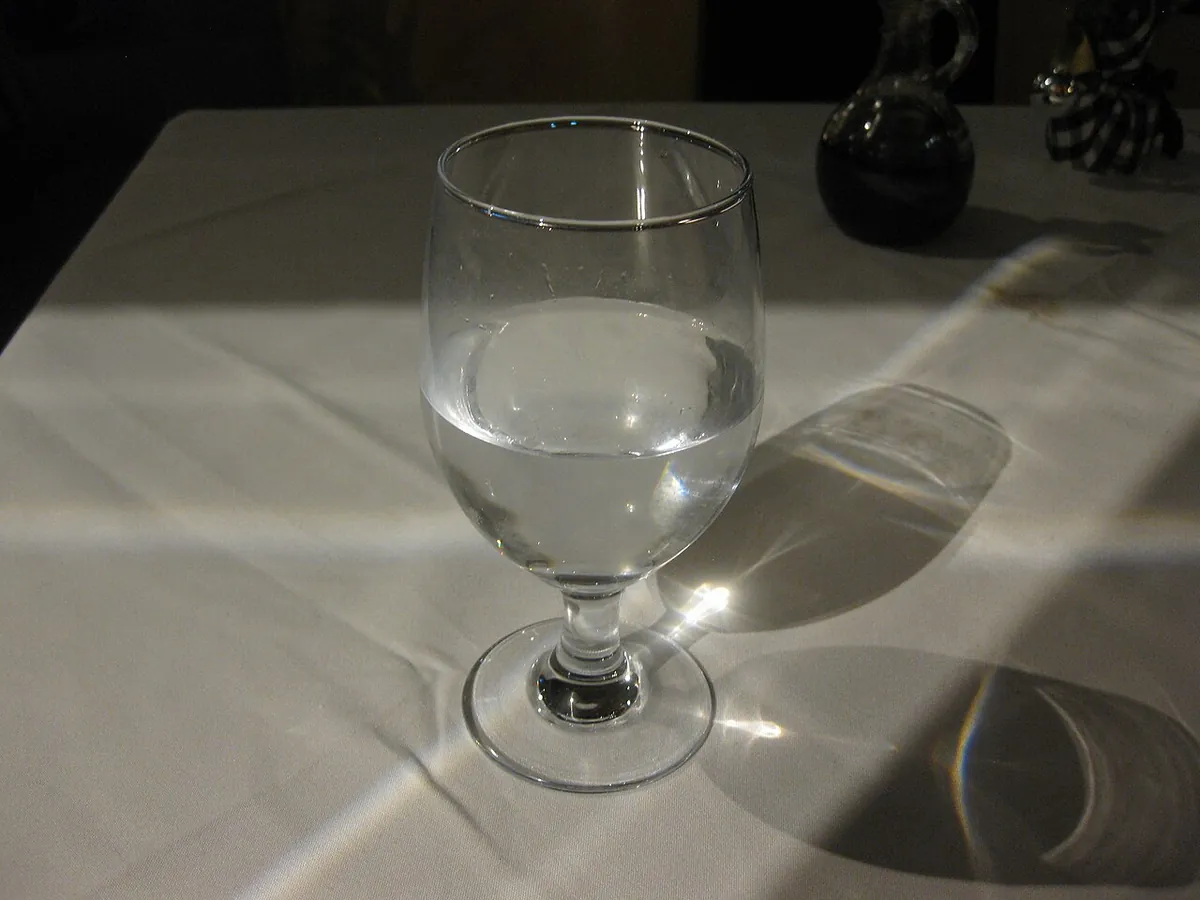
It sounds like common sense. Skin contains water, dry skin lacks water, so drinking more should top it up, the way you'd water a wilting plant. Influencers swear by it, and so do plenty of mums.
So we checked it in two steps: where the “8 × 8” rule comes from, and what happened when researchers actually made people drink more.
Following the number back
In 2002, Heinz Valtin, a physiologist at Dartmouth Medical School, went looking for the source of “drink at least eight 8-oz glasses of water a day”. He searched the literature and consulted nutritionists who specialise in thirst. His conclusion, in the American Journal of Physiology: no scientific study supports it, and surveys of thousands of healthy adults suggest such large amounts aren't needed by a largely sedentary adult in a temperate climate.
Europe's two-litre figure does have an official basis. The European Food Safety Authority (EFSA) sets an adequate intake of 2.0 litres of water a day for women and 2.5 litres for men. Read the small print, though: that's total water, from tap water, every kind of drink and the moisture in food. Soup, pasta and fruit all count. Two litres of plain water on top of everything else is not what EFSA says.
None of these guidelines mentions skin. They are about replacing what the body loses and keeping urine from getting too concentrated.
What the studies measured
The study everyone quotes comes from Portugal. Lídia Palma and colleagues published it in 2015 in Clinical, Cosmetic and Investigational Dermatology. Forty-nine women, 24 years old on average, added roughly two litres of water a day to their diet for a month. Skin hydration rose, both at the surface and deeper down, along with some measures of elasticity, mostly in women who usually drank less than 3.2 litres a day.
One detail closes the loop: the researchers picked that two-litre extra based on EFSA's reference values for women. The study's number came from the guideline, not the other way round.
In 2018, dermatologists at the Charité hospital in Berlin (Akdeniz and colleagues, Skin Research and Technology) pulled together everything published on the question. Out of 216 records, only six studies met their criteria. Their verdict: the evidence is weak, in quantity and in methodological quality. It points to a slight rise in hydration of the skin's outer layer, mainly in people who drank little to begin with, and slightly less dryness and roughness. Nobody knows the mechanism, and whether the effect holds in older people is unclear.
The case in five numbers
| What we know | Figure |
|---|---|
| Adequate total water intake, women (EFSA) | 2.0 L/day, food included |
| Adequate total water intake, men (EFSA) | 2.5 L/day, food included |
| Possible losses in extreme heat or hard exercise (EFSA) | up to about 8 L/day |
| Studies kept by the Charité review (2018) | 6 out of 216 records |
| Portuguese study (2015) | 49 women, 30 days |
These studies measure water in the skin with instruments, sometimes visible dryness too. None of them asks whether a face looks better.
Verdict: true if you barely drink, oversold for everyone else
If you drink very little, drinking more may nudge your skin's hydration up a bit. That's what both papers cautiously suggest. If you already drink to thirst, nothing shows an extra litre will change what you see in the mirror.
Dry skin is mostly an outside job. It's the outer layer that loses water to the air, and that's where central heating, long hot showers, harsh soaps and wind do their damage. The American Academy of Dermatology's tips for dry skin are almost all about what touches your skin, not what you drink.
Where drinking more really matters is heat and exercise. EFSA's figures assume moderate temperatures and moderate activity. In a heatwave or during long, hard exercise, losses can reach about eight litres a day, and they need replacing, salts included.
What actually hydrates skin
- Keep showers to 5–10 minutes in warm, not hot, water, with the bathroom door shut (AAD).
- Pat dry, then apply a fragrance-free moisturiser straight away while skin is still damp. Reapply whenever it feels tight.
- Use a gentle cleanser, just enough to remove dirt and oil, without working up a thick lather.
- In winter, with the heating on, run a humidifier in the bedroom and clean it regularly so mould doesn't grow.
- Seek shade when the sun is strongest (roughly noon to 4 pm in summer), wear a hat and covering clothes, build up exposure gradually without ever going red, and skip sunbeds.
- Drink to thirst, tea and coffee included, enough for your pee to be pale yellow (NHS), and more when it's hot or you exercise for long periods.
Common questions
- Do tea and coffee count?
- Yes. The NHS counts water, lower-fat milk and lower-sugar drinks, tea and coffee included, toward your daily fluids. Valtin reached the same conclusion about caffeinated drinks back in 2002.
- Can you drink too much water?
- In rare cases, yes. According to EFSA, adult kidneys can pass at most about a litre of urine an hour. Drinking far more than that can drive blood sodium dangerously low. It's unusual, but more isn't automatically better.
- My skin feels tight. Am I dehydrated?
- Not necessarily. Skin that feels tight after a shower or in winter is mostly short of water at the surface, because of dry air and washing. The simplest check on whether you drink enough is still the colour of your pee: pale yellow (NHS).
- How much should I drink in hot weather?
- There's no single number. Losses depend on the heat, the effort and the person. The NHS advises drinking more in hot weather, during long periods of activity or when you're ill, and EFSA notes that losses can reach about eight litres a day in extreme conditions.
When to talk to a doctor
If your skin stays dry, red or itchy despite these steps, it may be eczema or another skin condition, and a dermatologist can tell you. If you have kidney or heart disease, how much to drink is something to decide with your doctor, not a general rule. And intense thirst that won't go away always deserves a medical check.
Sources
- Dietary water affects human skin hydration and biomechanics — Clinical, Cosmetic and Investigational Dermatology, 2015
- Does dietary fluid intake affect skin hydration in healthy humans? A systematic literature review — Skin Research and Technology, 2018
- "Drink at least eight glasses of water a day." Really? Is there scientific evidence for "8 x 8"? — American Journal of Physiology – Regulatory, Integrative and Comparative Physiology, 2002
- Dietary Reference Values for nutrients — Summary report — EFSA Supporting Publications (Autorité européenne de sécurité des aliments), 2017
- Water, drinks and hydration — NHS (Royaume-Uni), 2023
- Dermatologists' top tips for relieving dry skin — American Academy of Dermatology, 2026
This information is general and does not replace advice from a doctor or dermatologist. For any concern about weight, skin or sleep, see a healthcare professional.