How to Be More Photogenic: A Step-by-Step Photo Session
Written by Visage Score, based on the studies cited at the end of the article.
You look fine in the mirror, then the front camera shows a stranger. Usually the problem isn't your face; it's the photo. Let's retake it together, one setting at a time, the way a photographer would walk you through a shoot.
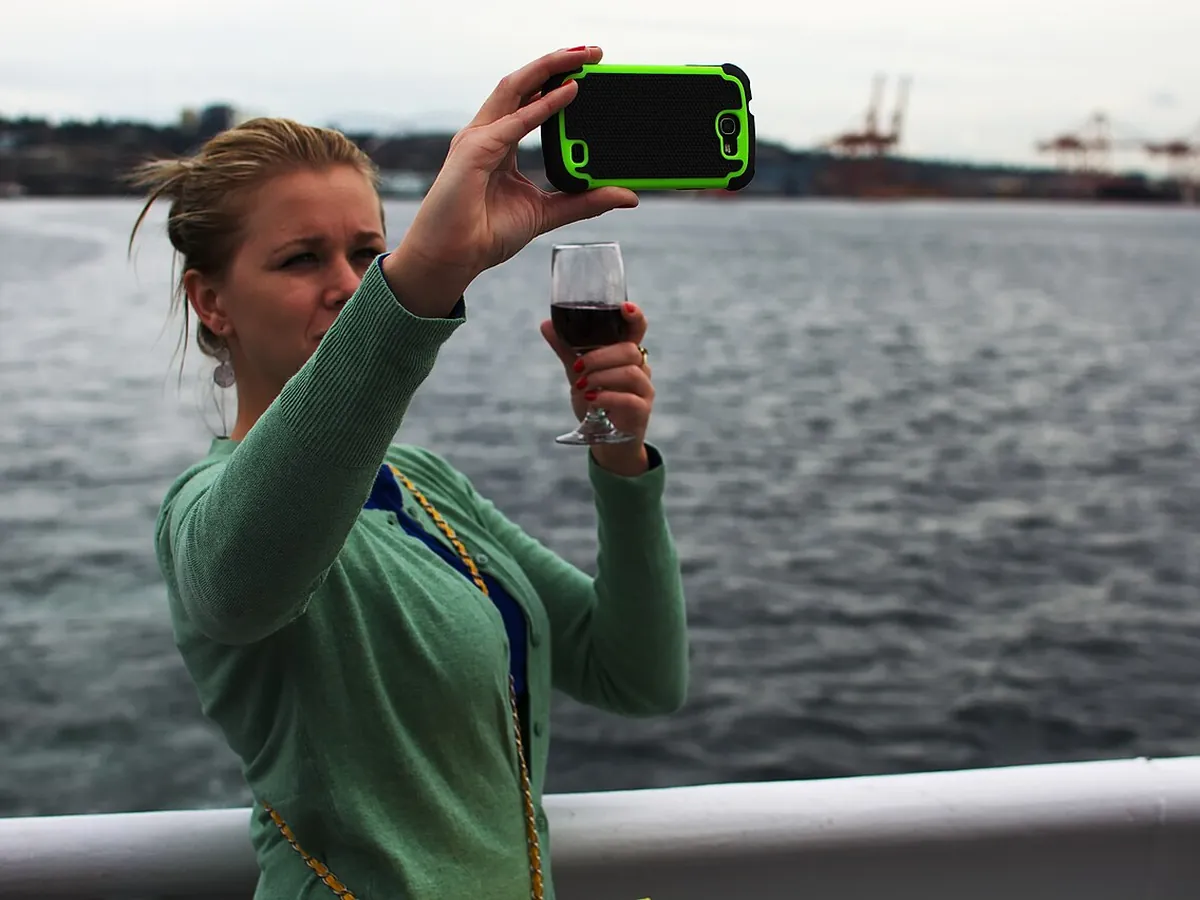
First, something reassuring. In 2011, psychologists at the University of Glasgow (Jenkins and colleagues, published in Cognition) collected many internet photos of the same people and had them rated. The attractiveness of one person varied more from photo to photo than it did between different people.
So the picture matters almost as much as the face, and the picture is the part you can control. Grab your phone. Here's the session.
Step 1: Move the camera back
This is the setting that changes the most, and almost nobody touches it. The closer the lens, the more whatever is nearest to it (your nose, the middle of your face) grows compared with what's farther away (your ears, the sides of your jaw).
A team from Rutgers and Stanford (Ward and colleagues, JAMA Facial Plastic Surgery, 2018) put numbers on it with a mathematical model of the face. A typical selfie, taken about 12 inches (30 cm) away, makes the base of the nose look roughly 30% wider than at 5 feet, a standard portrait distance. They started looking because patients were showing up with selfies, asking for nose surgery to fix what was really lens distortion.
It isn't only about noses. At Caltech, Bryan and colleagues (PLoS ONE, 2012) photographed the same faces at the same instant from about 18 inches and about 4.5 feet, using a half-silvered mirror. The close-up photos were rated less trustworthy, less competent and less attractive, and viewers couldn't say why.
What to do: prop your phone on a shelf about 5 feet away, set the self-timer, and use the 2x lens if you have one to keep a tight frame. No shelf? Ask a friend, or at least straighten your arm instead of holding the phone close.
Camera distance and what it does to your face
| Distance | What was measured |
|---|---|
| ≈ 12 in / 30 cm (typical selfie) | Nose base ≈ 30% wider and nose tip ≈ 7% wider than at 5 ft (Ward et al. model, 2018) |
| ≈ 18 in / 45 cm | Same face rated less trustworthy, competent and attractive than at 135 cm (Bryan et al., 2012) |
| ≈ 4.5 ft / 135 cm | The “far” distance in Bryan's experiment: ratings go back up |
| ≈ 5 ft / 1.5 m | Standard portrait distance used as the reference by Ward et al. |
These are two different studies: one is a geometric calculation, the other measures first impressions. They point the same way, but their numbers can't be stacked.
Step 2: Face the light
No study with numbers here, just photographers' rules you can test in a minute. Turn toward a window during the day, with the light on your face, not behind you. An overcast sky is the best free filter there is: it softens shadows and evens out skin.
Avoid the ceiling light right above your head. It hollows out your eye sockets and draws dark circles you don't have. The same goes for harsh midday sun, which makes you squint. If a lamp is all you have, put it in front of you, slightly to one side, at face height.
Step 3: Get the lens at eye level
Keep the lens level with your eyes or just above. Shot from below, the camera sees the underside of your chin and your nostrils first, which is the same perspective logic as step 1: whatever is closest gets bigger.
A trick portrait photographers use: push your forehead slightly toward the lens and drop your chin a little. It feels odd, but in the photo your jawline comes out much more clearly.
Step 4: Set your posture
Stand tall, shoulders down and loose. Turn your torso a quarter away, then bring just your face back to the camera. At three-quarters, your body looks less boxy and your face keeps its depth. If you have a “good side,” use it, but try both; people often guess wrong.
Let your hands relax. An arm pressed against your body flattens and looks wider, so leave a little gap between arm and waist.
Step 5: Smile like you mean it
A smile that reaches the eyes, with crinkles at the corners, is called a Duchenne smile. A meta-analysis by Gunnery and Ruben (Cognition and Emotion, 2016) pooled the studies comparing it with a mouth-only smile. Duchenne smiles were rated as more genuine, more trustworthy and more attractive.
One useful detail: the gap was bigger when smiles happened naturally than when they were posed on cue. So skip “say cheese.” Think of someone who makes you laugh, or shoot a burst while you talk, and pick the best frame afterwards.
Step 6: When comparing, change only one thing
If you want to know whether your skin, sleep or new haircut is making a difference, compare photos taken under the same conditions: same distance, same window, same time of day, same expression. Otherwise you're measuring the lighting, not your face. That's exactly why serious studies photograph people twice in an identical setup.
For your Visage Score progress photos, pick one spot at home and mark it on the floor. Thirty extra seconds, and your before-and-after finally means something.
Your photo session checklist
- Phone about 5 feet away on a stand, self-timer on, 2x lens.
- Face a window, ideally on a cloudy day; no ceiling light overhead.
- Lens at eye level, forehead slightly forward, chin a touch down.
- Torso turned three-quarters, shoulders relaxed, a gap between arm and waist.
- A burst while talking or laughing instead of a frozen smile.
- To compare two photos: same place, same time, same distance.
Common questions
- Do selfies really distort your face?
- Yes, through simple perspective. At about 12 inches, the Ward et al. (2018) model estimates the base of the nose looks around 30% wider than at 5 feet. Your face didn't change; the lens was too close.
- Why do I look different in every photo?
- Light, angle, distance and expression change a lot. The Glasgow study (Jenkins et al., 2011) found that one person's attractiveness varied more across their own photos than between different people.
- Should I smile in my profile picture?
- A genuine smile that reaches the eyes is rated warmer and more attractive than a mouth-only one. For a very formal photo, a slight smile is enough; what matters is that it isn't forced.
- Aren't beauty filters easier?
- They fix the image, not the cause. The free settings on this page prevent most of the flaws people later try to blur out, and they keep your photos comparable month after month.
What this research doesn't show
The 30% figure comes from a geometric model, not from measuring real faces, and two vision scientists, Cooper and Banks, replied in the same journal (2018) that the effect also depends on how far away you hold the photo when looking at it. None of these settings changes your face or guarantees a better score. If one feature bothers you so much that you avoid cameras or are considering surgery because of your selfies, talk to a doctor first. That kind of worry deserves attention in its own right.
Sources
- Nasal Distortion in Short-Distance Photographs: The Selfie Effect — JAMA Facial Plastic Surgery, 2018
- Why selfies make your nose look bigger (Rutgers University) — Futurity, 2018
- Perceived Facial Distortions in Selfies Are Explained by Viewing Habits — JAMA Facial Plastic Surgery, 2018
- Perspective distortion from interpersonal distance is an implicit visual cue for social judgments of faces — PLoS ONE, 2012
- Perceptions of Duchenne and non-Duchenne smiles: A meta-analysis — Cognition and Emotion, 2016
- Variability in photos of the same face — Cognition, 2011
This information is general and does not replace advice from a doctor or dermatologist. For any concern about weight, skin or sleep, see a healthcare professional.