How to Grow Thicker Eyebrows: Three Real-Life Cases
Written by Visage Score, based on the studies cited at the end of the article.
There's no single answer to “how do I get thicker eyebrows?” Someone who overplucked in the 2000s, someone born with sparse brows, and someone watching them fade at fifty are in very different spots. Let's follow all three.
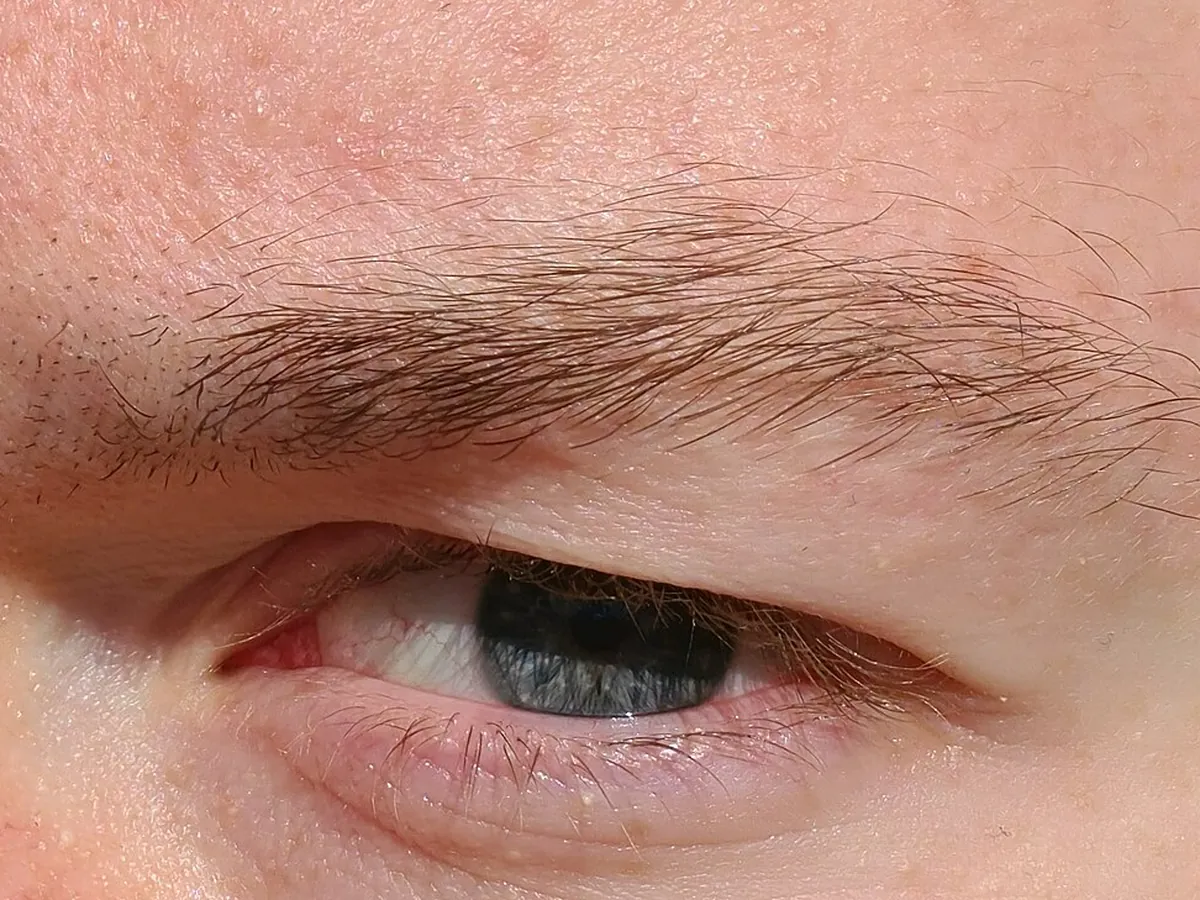
First, why brows matter so much. In 2003, an MIT team (Sadr, Jarudi and Sinha, published in Perception) showed volunteers edited photos of celebrities, either without eyes or without eyebrows. Faces missing their brows were much harder to recognize, even harder than faces missing their eyes. Brows frame the face more than we give them credit for.
Shape plays a part too. A Chinese study in Frontiers in Psychology (Zhao and colleagues, 2019) analyzed 300 East Asian women's faces scored by an algorithm. The top-rated faces paired arched brows with smaller eyes and a round face, or straighter brows with larger eyes and a longer face. So there's no perfect brow, just one that fits the rest of your face.
How an eyebrow hair grows
Eyebrow hairs live fast. According to a review by University of Miami dermatologists (Nguyen, Hu and Tosti, American Journal of Clinical Dermatology, 2023), the growth phase typically lasts two to three months, followed by two to three weeks of transition and two to three months of rest before the hair sheds. On your scalp, the growth phase lasts two to eight years. That's why brows stay short, and why regrowth takes patience: Cleveland Clinic says to expect at least two to three months before you see new hair.
Hold on to that number. It comes up in all three stories.
Jess, 29: the tweezers from high school
Jess started plucking at fourteen, back when pencil-thin brows were everywhere. Fifteen years later she wants the opposite, but some patches stay sparse, especially toward the tail.
Pulling a hair now and then doesn't destroy the follicle. Doing it for years can. The Miami review lists overplucking among the traumatic causes of eyebrow loss, and a dermatologist quoted by Cleveland Clinic puts it bluntly: plucking every day damages the follicle and can even cause scarring, and then the hair won't grow back.
What Jess can do: put the tweezers away for at least three to four months, a full cycle, without “tidying up” strays. Brush her brows upward every morning to see what returns. Fill in with pencil or powder meanwhile. If nothing has changed after four months, Cleveland Clinic suggests seeing a dermatologist, who can discuss options such as a transplant for areas that no longer grow.
Marcus, 34: sparse brows since forever
Marcus has never touched his brows. They're just light and thin, like his dad's. No routine will create follicles that aren't there.
His options are about drawing, not growing. A pencil or powder close to his hair color, applied in short strokes in the direction of growth, adds density without looking made up. A professional tint darkens light hairs for a few weeks. A bigger commitment is microblading, which places pigment under the skin in fine strokes: it's a tattoo, lasting 12 to 18 months according to the Miami review. Choose it knowingly, from a licensed practitioner who follows proper hygiene, and never because you feel you have to.
Linda, 52: the outer brow fading away
Linda barely plucks anymore. Yet over one year, the outer third of her brows has thinned out, and her hairline has crept back a little at the temples.
This is no longer a beauty question. Losing the outer third of the eyebrows is a classic, though not specific, sign of an underactive thyroid (Kumar and Karthikeyan, International Journal of Trichology, 2012). And frontal fibrosing alopecia, which pushes the hairline back mostly after menopause, affects the eyebrows in up to 96% of patients according to the Miami review. It's a scarring condition: the earlier it's caught, the more can be preserved.
What Linda can do: book her doctor, then a dermatologist. When the cause is treated and the loss hasn't scarred, the hair generally grows back (Kumar and Karthikeyan, 2012).
What about castor oil?
It's the remedy everyone passes along, and all three have tried it. A 2022 systematic review (Phong and colleagues, Journal of Drugs in Dermatology) looked at 22 articles on castor, coconut and argan oils. For castor oil, there was weak evidence of shinier hair and no strong evidence of any effect on growth. It's a tradition, not a proven treatment, and it won't replace Jess's patience or Linda's appointment.
What you can start tonight
- Put the tweezers away: three to four months with no plucking, strays included.
- Brush your brows upward each morning to spot regrowth.
- Take a photo every month, same light, same distance, so you judge on evidence.
- Fill gaps with pencil or powder in short strokes rather than a solid block.
- Avoid rubbing or scratching the area, especially if the skin is dry or irritated.
- If nothing changes after four months, or you notice any warning sign below, get it checked.
Common questions
- How long do eyebrows take to grow back?
- Expect at least two to three months before you see a change, and three to four months to judge, which is one full cycle. The longer and more often you plucked, the less certain regrowth is.
- Does castor oil make eyebrows grow?
- It hasn't been shown to. The systematic review by Phong et al. (2022) found no strong evidence of an effect on growth, only weak evidence of shinier hair.
- Does microblading damage your brows?
- It's a tattoo: pigment placed in the skin, which triggers a mild inflammatory reaction and lasts 12 to 18 months. It doesn't grow hair. Pick a reputable, licensed practitioner and ask what happens if you don't like the result.
- My brows are falling out in round patches. Is that serious?
- Round or oval bald patches can point to alopecia areata, an autoimmune condition. It isn't an emergency, but it needs a diagnosis from a dermatologist.
When to see a doctor or dermatologist
Get checked if your brows fall out suddenly or in patches, if the outer third disappears (especially with tiredness, feeling cold or weight gain), if your hairline is receding at the same time, if the skin underneath is red, flaky or itchy, or if the loss started after a new medication. And if you find it hard to stop pulling your hairs, that has a name, trichotillomania, and it's treatable; a doctor can point you to help. Prescription treatments exist, but they're for your doctor to discuss, not to try on your own.
Sources
- The role of eyebrows in face recognition — Perception, 2003
- Data-Driven Research on the Matching Degree of Eyes, Eyebrows and Face Shapes — Frontiers in Psychology, 2019
- Eyebrow and Eyelash Alopecia: A Clinical Review — American Journal of Clinical Dermatology, 2023
- How Long Does It Take Eyebrows To Grow Back? — Cleveland Clinic, 2026
- Madarosis: a marker of many maladies — International Journal of Trichology, 2012
- Coconut, Castor, and Argan Oil for Hair in Skin of Color Patients: A Systematic Review — Journal of Drugs in Dermatology, 2022
This information is general and does not replace advice from a doctor or dermatologist. For any concern about weight, skin or sleep, see a healthcare professional.