Does Sugar Age Your Skin? What Glycation Really Does
Written by Visage Score, based on the studies cited at the end of the article.
Put a slice of bread in the toaster and it turns brown and crisp in a couple of minutes. That's sugars reacting with proteins. A very slow version of the same chemistry happens in your skin. The real question is how much your sweet tooth speeds it up.
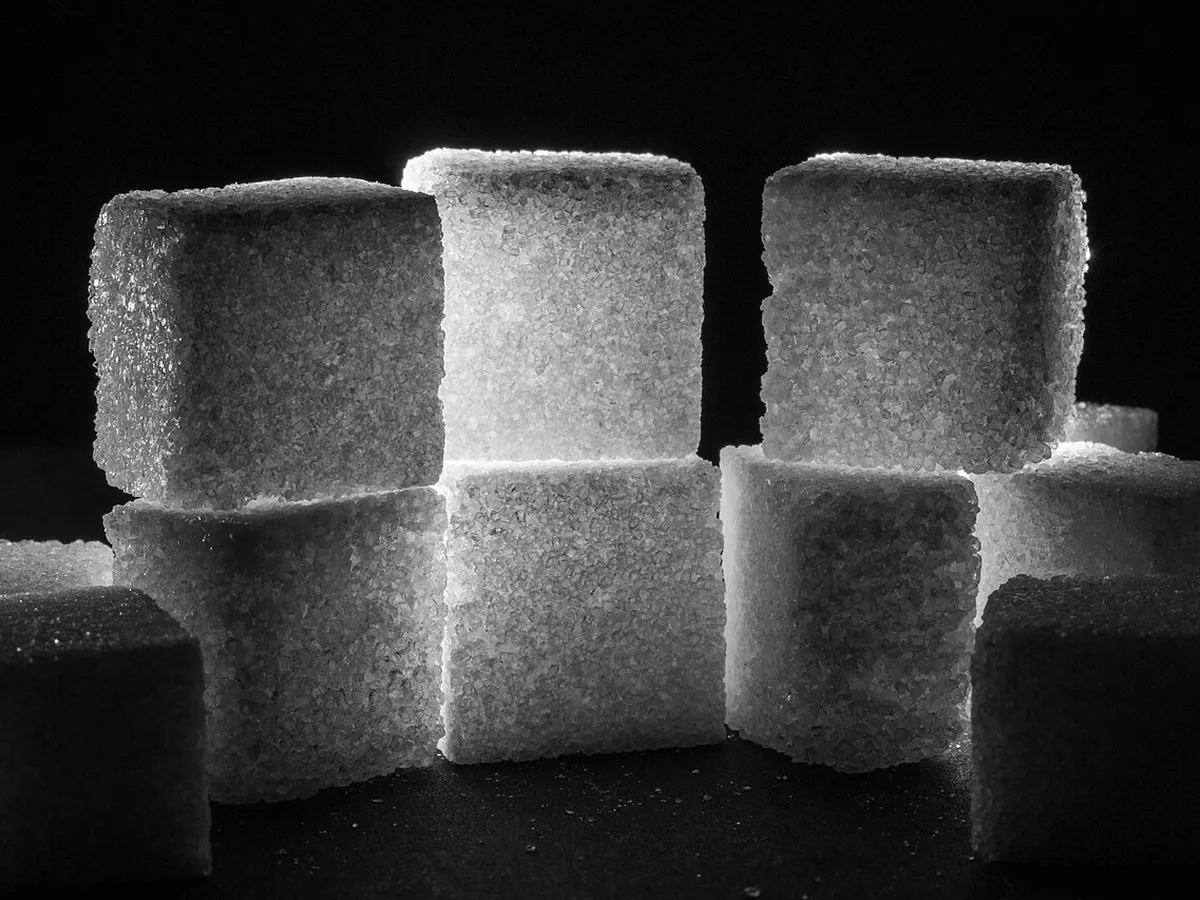
Toast, in slow motion
Food scientists call it the Maillard reaction, after the French chemist Louis-Camille Maillard, who described it in 1912. A sugar such as glucose or fructose latches onto a protein without any enzyme involved. At 400 °F it takes minutes and gives you toast, the crust on a seared steak, the flavor of caramel.
Inside the body, at 98.6 °F, the same family of reactions runs far more slowly. It's called glycation. Sugars circulating in the blood attach to proteins and, after several steps, form stable compounds known as advanced glycation end products, or AGEs.
Skin is a prime target because its collagen turns over very slowly, roughly once a decade according to a review by Paraskevi Gkogkolou and Markus Böhm (Dermato-Endocrinology, 2012). A protein that stays in place that long has plenty of time to "brown."
Dermatologist Frank Danby (Clinics in Dermatology, 2010) describes what happens next: glycation welds collagen fibers to each other. A cross-linked fiber becomes stiff and hard to repair, and skin built on stiffer collagen loses its spring. He adds that the process speeds up when blood sugar runs high, and that UV light stimulates it in the skin.
Glycation in skin, by the numbers
| What was measured | Value |
|---|---|
| Age at which glycated collagen first shows up | around 20 |
| Increase in glycated collagen by age 80 | +30–50% |
| Turnover time of skin collagen | about 10 years |
| Share of dietary AGEs absorbed into the blood | 10–30% |
Figures compiled by Gkogkolou and Böhm (2012). They describe something that happens to everyone, sweet tooth or not: glycation is part of normal aging, and the sugar on your plate is only one of its fuels.
Proven, plausible, or just extrapolated?
Proven: AGEs exist in human skin, build up with age, are far more abundant in people with diabetes, and form faster in smokers. These come from measurements on human tissue.
Plausible: since high blood sugar speeds up the reaction, a diet that keeps spiking it should produce somewhat more AGEs. The logic holds, but it's still logic, not a result.
Not shown: that cutting sugar makes skin look visibly younger in someone without diabetes. Much of the experimental work was done on cells in a dish or on mice, and the 2012 review itself says controlled human studies on skin aging are largely missing. Headlines promising that quitting sugar will erase wrinkles skip that step entirely.
Acne: the one solid human trial
For breakouts, there is a controlled trial. In Melbourne, Robyn Smith and colleagues (American Journal of Clinical Nutrition, 2007) followed 43 young men with acne, aged 15 to 25, for 12 weeks. Half ate a low-glycemic-load diet, with more protein and carbs that raise blood sugar slowly; the other half got no guidance on that front.
After three months, lesion counts had dropped by 23.5 on average in the low-glycemic group versus 12.0 in the control group. But that group also lost 2.9 kg (about 6 lb), and the authors acknowledge they can't separate the effect of the diet from the weight loss. An encouraging signal, not proof that sugar alone causes acne.
What actually makes a face look older
When researchers look for what makes people look their age, the human data point elsewhere. At the Twins Days festival in Twinsburg, Ohio, a plastic surgery team (Guyuron et al., Plastic and Reconstructive Surgery, 2009) photographed 186 pairs of identical twins. Same genes, different lives: the longer a twin had smoked, the older they looked than their sibling, and unprotected sun exposure pushed in the same direction.
Another study (International Journal of Cosmetic Science, 2014) retouched portraits of women in their sixties. On Chinese faces, removing dark spots took 4.0 years off the estimated age, versus 1.9 years for wrinkles. Those spots come mostly from UV. Before you hunt down the hidden sugar in your granola, keeping strong sun off your face and quitting cigarettes matter a lot more.
What to do, from most to least useful
- Protect your face from strong sun every day, not just at the beach: shade at peak hours, a hat or cap, never getting red. It prevents the most spots and wrinkles, and UV also speeds up glycation.
- Don't smoke, or quit. Tobacco ages the face through several routes at once, glycation included.
- Start with sweet drinks (soda, sweet tea, sports drinks, juice) rather than the square of chocolate. The WHO recommends keeping free sugars under 10% of daily calories, about 50 g or 12 level teaspoons on a 2,000-calorie day.
- Keep fruit whole. The WHO advises at least 400 g of fruit and vegetables a day, and the sugar in whole fruit doesn't count as free sugar, unlike the sugar in juice.
- Mix up your cooking: boiled, steamed and stewed more often than deep-fried or charred. Fried food contains far more AGEs than boiled or steamed food. A weekend cookout isn't the issue; fries every day are more of one.
- Skip "anti-glycation" supplements. Their effect on how human skin looks hasn't been demonstrated.
Questions people ask
- Is honey or maple syrup better than white sugar for skin?
- The WHO counts the sugar in honey, syrups and fruit juice as free sugar, exactly like table sugar. Swapping one sweetener for another changes little; using less of it is what counts.
- If I quit sugar, will my wrinkles go away?
- No. Collagen that's already glycated turns over across roughly a decade, and no study has shown a low-sugar diet erasing wrinkles. Cutting back is still a good idea for your overall health, just without promises about the mirror.
- Should I switch to artificial sweeteners?
- The WHO specifically recommends reducing free sugars without turning to non-sugar sweeteners. The goal is to get used to food tasting less sweet, not to fool your taste buds.
- Does chocolate cause breakouts?
- The 2007 trial looked at the glycemic load of the whole diet, not any single food. If you think you see a link, keep a simple log of what you eat and how your skin looks for a few weeks before cutting anything out.
When to see a professional
If you have diabetes or prediabetes, glycation affects far more than your skin: managing your blood sugar with your doctor matters, not a beauty routine. For acne that scars or won't clear, a dermatologist has treatments that go well beyond what diet can do. And if you want to overhaul how you eat, a registered dietitian can help you do it without banning entire foods.
Sources
- Nutrition and aging skin: sugar and glycation — Clinics in Dermatology, 2010
- Advanced glycation end products: Key players in skin aging? — Dermato-Endocrinology, 2012
- A low-glycemic-load diet improves symptoms in acne vulgaris patients: a randomized controlled trial — The American Journal of Clinical Nutrition, 2007
- Factors contributing to the facial aging of identical twins — Plastic and Reconstructive Surgery, 2009
- Influence of skin ageing features on Chinese women's perception of facial age and attractiveness — International Journal of Cosmetic Science, 2014
- Healthy diet (fact sheet) — World Health Organization, 2026
This information is general and does not replace advice from a doctor or dermatologist. For any concern about weight, skin or sleep, see a healthcare professional.